As demand for computing power continues to grow, traditional data center infrastructure is struggling to keep pace. Grid connection delays, long equipment lead times, and increasing AI workloads are making it more difficult for organizations to bring new computing capacity online.
Mobile data centers offer a practical alternative. These self-contained facilities can be deployed much faster than traditional data centers, providing computing capacity where and when it’s needed.
Once primarily used in military and defense applications, mobile and containerized data centers are becoming an increasingly important solution for commercial, industrial, and government organizations.
What Is a Mobile Data Center?
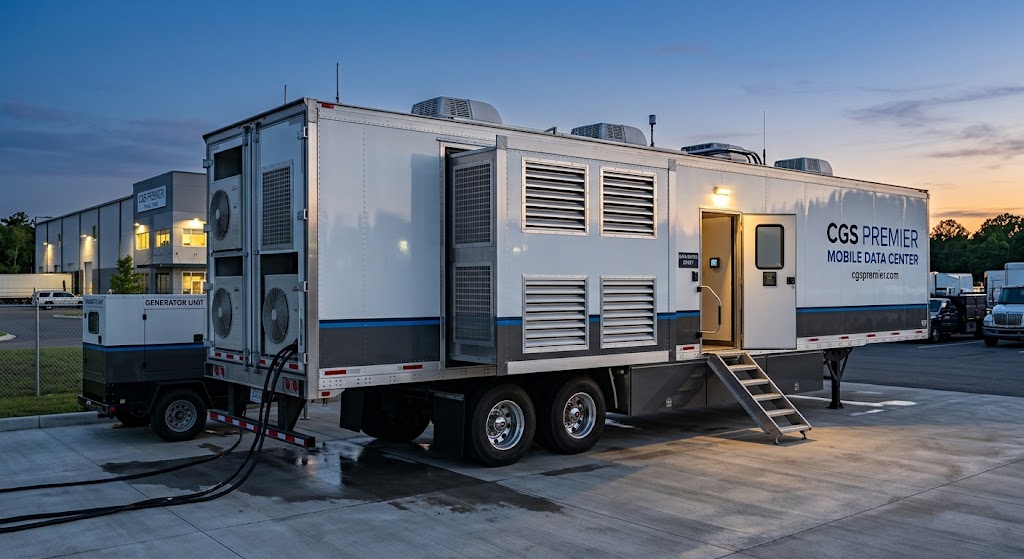
A mobile data center is a self-contained computing facility housed inside a transportable enclosure, such as a shipping container, trailer, or custom-built POD.
Each unit is designed to support essential data center infrastructure, including power distribution, cooling, fire suppression, and equipment racking. Once delivered, it can be connected to power and network infrastructure and begin operating without requiring a traditional building.
Mobile data centers come in several configurations:
- Containerized data centers: Built inside standard 20-foot or 40-foot shipping containers, these units can be transported by truck, rail, or vessel and positioned using a crane.
- Trailer-mounted data centers: Built onto a trailer chassis, these units can be relocated using a standard tractor without requiring a crane.
- Skid-mounted or POD systems: Modular structures designed for semi-permanent installations that can be expanded or reconfigured as computing needs change.
- Tactical and ruggedized units: Specialized facilities engineered for military operations, remote locations, and challenging environments.
The right configuration depends largely on how frequently the unit needs to move. A facility designed for regular relocation requires different structural, cooling, and transportation considerations than one intended to remain in place for several years.
Mobile vs. Modular vs. Traditional Data Centers
While all three options provide computing infrastructure, they differ in deployment time, mobility, and site requirements.
| Feature | Traditional | Modular/Prefabricated | Mobile |
| Deployment time | 3–7 years | 6–18 months | Weeks to months |
| Foundation | Permanent construction | Permanent pad | Pad, gravel, or potentially none |
| Relocatable | No | Difficult | Yes |
| Power source | Grid connection | Grid connection | Grid, generator, or hybrid |
| Best suited for | Long-term computing needs | Planned capacity expansion | Temporary capacity, edge computing, and remote operations |
Traditional data centers remain an effective option for organizations with predictable, long-term computing requirements. Modular facilities can shorten construction timelines by using prefabricated components.
Mobile data centers provide greater flexibility, particularly when computing capacity is needed quickly or in locations where permanent infrastructure is unavailable.
Why Demand for Mobile Data Centers Is Growing in 2026
Several factors are driving increased interest in mobile computing infrastructure, including power availability, AI growth, and the need for processing closer to where data is generated.
Power Availability Is Becoming a Major Challenge
As AI infrastructure expands, access to reliable electrical power has become one of the biggest obstacles to new data center development.
According to the 2026 JLL Global Data Center Outlook, developers seeking a 100-megawatt grid connection in Northern Virginia may face wait times of approximately seven years.
The challenge extends beyond individual markets. By mid-2026, ERCOT’s large-load interconnection queue had reached approximately 427 gigawatts, with data centers accounting for most of that demand. National interconnection queues have also exceeded 2,000 gigawatts.
Equipment availability adds another layer of complexity. Substation transformer lead times have extended beyond 160 weeks, with some high-voltage equipment requiring 36 to 48 months. Google has also highlighted transmission infrastructure delays as a growing constraint on data center development.
For organizations that cannot wait years for a permanent grid connection, mobile data centers offer an alternative.
When paired with on-site power generation, these facilities can provide computing capacity while permanent electrical infrastructure is being developed.
Rather than replacing traditional data centers, mobile units can help bridge the gap between immediate computing requirements and long-term infrastructure availability.
Edge Computing Requires More Distributed Infrastructure
Not every computing workload can operate efficiently from a centralized data center.
Applications such as industrial automation, autonomous systems, real-time video analytics, and 5G networks often require processing close to where information is generated.
This approach, known as edge computing, helps reduce latency and supports applications that depend on rapid data processing.
However, many edge computing locations lack suitable buildings or existing data center infrastructure.
Manufacturing facilities, ports, mining operations, substations, and other industrial sites may need computing capacity without the space or resources required for permanent construction.
Containerized and mobile data centers make it possible to deploy infrastructure directly at these locations.
Market Growth Reflects Increasing Demand
Industry forecasts point to continued growth in modular and mobile data center infrastructure.
MarketsandMarkets projects the modular data center market will grow from approximately $41 billion in 2026 to $93.6 billion by 2031, representing an annual growth rate of roughly 18%.
Other industry forecasts estimate similar growth rates in the 17% to 18% range, while Technavio projects annual growth exceeding 22%.
Although estimates vary based on how each report defines the market, the overall trend is consistent: organizations are investing more heavily in flexible, prefabricated computing infrastructure.
Common Applications for Mobile Data Centers
Mobile data centers support a wide range of industries and operational requirements.
Temporary and Bridge Computing Capacity
Organizations can deploy mobile units to support computing operations while waiting for permanent facilities, grid connections, or infrastructure upgrades.
This allows businesses to maintain operations and add capacity without waiting for long construction timelines.
Edge Computing and Distributed AI
Manufacturing facilities, telecommunications providers, and logistics operations can position computing infrastructure closer to where data is generated.
This supports applications that require low latency, including real-time analytics and AI inference.
Disaster Recovery and Business Continuity
Mobile data centers can help restore computing capabilities when permanent facilities are damaged, unavailable, or experiencing outages.
Government agencies, utilities, healthcare organizations, and other critical infrastructure operators can use these facilities to support continuity and recovery efforts.
Military and Defense Operations
Defense organizations use mobile computing facilities to support secure communications, command and control operations, and field-based data processing.
These units are often designed to withstand demanding transportation and environmental conditions.
Remote Industrial Operations
Mining, energy, and construction operations frequently take place in locations with limited access to permanent infrastructure.
Mobile data centers provide localized computing and data storage capabilities without requiring a dedicated building.
Broadcast and Live Events
Mobile facilities can support the computing, storage, and transmission requirements of live broadcasts, sporting events, and other temporary productions.
Because the infrastructure can travel between locations, organizations can reuse the same facility across multiple events.
Key Considerations When Building a Mobile Data Center
While computing equipment is an important part of any data center, the supporting infrastructure is equally critical.
A successful mobile data center must be engineered to accommodate power requirements, cooling demands, transportation conditions, and ongoing maintenance.
Thermal Management and Cooling
High-performance computing equipment generates significant heat, particularly in applications involving AI accelerators and high-density server racks.
Inside a compact enclosure, maintaining appropriate operating temperatures requires careful planning.
Cooling systems must account for equipment heat loads, enclosure size, airflow, and the environmental conditions at each deployment location.
Higher-density computing applications may also require liquid cooling systems, introducing additional considerations for plumbing, leak detection, and transportation stability.
Power Distribution and Electrical Systems
Mobile data centers may operate using utility power, on-site generators, or a combination of both.
Their electrical systems must support reliable power distribution, equipment protection, and transitions between power sources.
Depending on the application, this may include AC and DC distribution, power conditioning, and uninterruptible power supply (UPS) systems.
Designing for future capacity is also important. Adequate electrical headroom can help accommodate additional equipment without requiring major infrastructure modifications.
Fire Detection and Suppression
Fire protection is essential in any enclosed computing environment.
Mobile data centers require appropriately designed detection and suppression systems that protect equipment while accounting for the facility’s size, airflow, and operating conditions.
These systems should be incorporated into the overall enclosure design rather than treated as separate components.
Structural Design and Transportation
Unlike equipment installed in permanent buildings, mobile data center components may experience vibration, movement, and additional structural loads during transportation.
Equipment mounting, bracing, and vibration isolation must be designed around the intended transportation method.
The enclosure itself must also withstand lifting, towing, or other handling requirements without compromising the equipment inside.
Equipment Access and Maintenance
Accessibility plays an important role in the long-term operation of a mobile data center.
Technicians need practical ways to install, inspect, maintain, and replace heavy computing equipment.
Ground-level access can simplify these tasks by reducing the need for ramps, lift gates, or additional lifting equipment.
CGS Premier’s patented Drop Trailer technology (U.S. Patent 9,868,380) uses a self-contained hydraulic system to lower the trailer floor to ground level.
Originally developed for mobile healthcare applications, this design can also support easier equipment loading and unloading in mobile computing environments.
Security and Environmental Protection
Mobile data centers may operate in locations with varying levels of physical security and environmental exposure.
Depending on the application, facilities may require access control, intrusion detection, surveillance, and protection against dust and moisture.
A unit deployed at a remote industrial site, for example, may require different security and environmental safeguards than one installed within an existing secured campus.
How CGS Premier Supports Mobile Data Center Projects
CGS Premier specializes in designing and fabricating custom mobile infrastructure, including containers, trailers, and purpose-built POD systems.
Rather than supplying computing hardware, we focus on the physical infrastructure required to support it.
Our team works with customers and their IT partners to develop custom enclosures and integrate the systems needed for reliable operation.
Our capabilities include:
- Custom container and trailer modifications
- HVAC load calculations and system installation
- Fire suppression system design and installation
- AC and DC power distribution and wiring
- Custom equipment racking and mounting
- Precision machining and fabrication
- Hydraulic systems and specialized access solutions
With more than 30 years of experience building custom mobile infrastructure, CGS Premier brings expertise from government, industrial, and mobile healthcare applications.
Our experience includes mobile medical imaging facilities designed to accommodate MRI and CT equipment, which require specialized power, cooling, shielding, and vibration control.
CGS Premier is an ISO 9001 registered manufacturer and holds GSA contract vehicles supporting federal procurement.
All fabrication takes place at our facility in Muskego, Wisconsin.
Questions to Consider Before Choosing a Mobile Data Center
Every mobile data center project has different operational requirements. Before selecting an enclosure or configuration, organizations should consider several important questions.
How Frequently Will the Unit Move?
A data center that needs to relocate several times a year requires a different structural and transportation design than one intended to remain at a single location for an extended period.
Understanding actual mobility requirements can help avoid unnecessary costs and complexity.
What Are the Current and Future Power Requirements?
Power and cooling systems should accommodate both immediate computing needs and anticipated growth.
Planning for future rack density can reduce the likelihood of expensive modifications later.
Where Will the Unit Be Deployed?
Climate and environmental conditions directly influence enclosure design, insulation, cooling, and equipment protection.
A facility operating in extreme summer heat may require a different approach than one exposed to prolonged freezing temperatures.
Units intended for multiple climates must be engineered accordingly.
What Power Sources Will Be Available?
Whether a unit operates from utility power, generators, or a hybrid configuration affects its electrical architecture and overall design.
On-site generation may also introduce additional space and fuel storage requirements.
Who Will Maintain the Equipment?
Maintenance capabilities should influence equipment layout, accessibility, and system complexity.
Facilities maintained by specialized data center technicians may support different configurations than units serviced by general on-site personnel.
The Future of Mobile Data Centers
Mobile data centers are not expected to replace traditional hyperscale facilities. Permanent data centers will continue to play an essential role in supporting large-scale computing operations.
However, increasing power constraints, infrastructure delays, and demand for distributed computing are changing how organizations approach capacity planning.
Mobile data centers provide an alternative when permanent infrastructure cannot be built quickly enough or when computing requirements extend beyond traditional facilities.
For applications involving temporary capacity, edge computing, remote operations, and disaster recovery, the ability to deploy and relocate computing infrastructure offers meaningful operational advantages.
As demand for flexible computing solutions continues to grow, mobile data centers are positioned to become an increasingly important part of modern infrastructure strategies.
Frequently Asked Questions About Mobile Data Centers
What is a mobile data center?
A mobile data center is a self-contained computing facility housed in a transportable enclosure, such as a shipping container, trailer, or custom POD. It includes supporting infrastructure such as power distribution, cooling, fire suppression, and equipment racking, allowing it to operate without a permanent building.
How is a mobile data center different from a modular data center?
Modular data centers are typically prefabricated and installed at a permanent location. Mobile data centers are specifically engineered for transportation and relocation, with structural and equipment designs that accommodate movement.
How long does it take to deploy a mobile data center?
Mobile data centers can often be deployed within weeks to months, depending on equipment specifications, power requirements, cooling systems, and site readiness. This is generally faster than traditional data center construction, which can take several years.
Can a mobile data center operate without a grid connection?
Yes. Mobile data centers can be designed to operate using on-site generators, utility power, or hybrid systems. This flexibility allows organizations to deploy computing infrastructure in remote locations or while waiting for permanent grid connections.
What industries use mobile data centers?
Mobile data centers are used in AI and cloud computing, telecommunications, manufacturing, defense, government, healthcare, energy, mining, and broadcast operations. They are particularly valuable when computing infrastructure must be deployed quickly or in locations without permanent facilities.
Build a Mobile Data Center Designed for Your Needs
CGS Premier designs and fabricates custom mobile infrastructure tailored to your power, cooling, transportation, and equipment access requirements.
From containerized solutions to specialized trailers and POD systems, our team can help develop the physical infrastructure needed to support your mobile computing operations.
Tell us what you need to deploy and where. We’ll help determine what it takes to build it.